
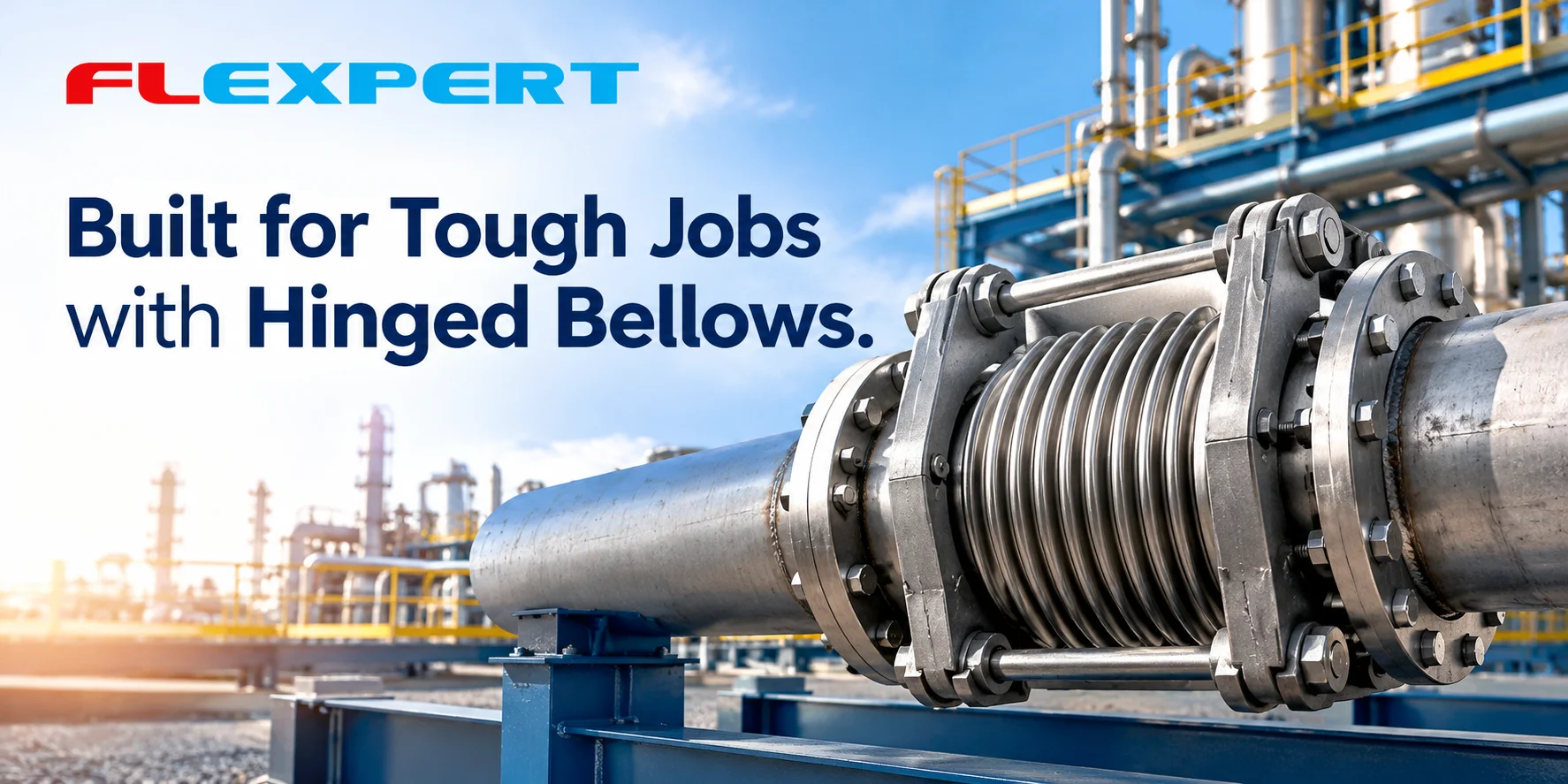
Industrial pipelines rarely stay still. Heat makes them expand, operating conditions create movement, and heavy machinery introduces forces that ordinary connections may struggle to handle. In such environments, choosing the right expansion joint matters. A reliable hinged bellows manufacturer can help industries manage angular movement while supporting dependable pipeline performance in demanding applications.
Why Hinged Bellows Matter in Heavy-Duty Industries?
Industrial systems face constant challenges from temperature changes, vibration, pressure fluctuations, and equipment movement. Without a suitable expansion joint, these forces may transfer excessive loads to pipes, supports, and connected machinery.
Hinged bellows expansion joints are designed primarily to accommodate angular rotation around a defined hinge axis. Their hardware helps control the direction of movement and can restrain pressure-induced axial thrust, subject to the joint's design and installation. This makes them useful in selected piping arrangements where controlled movement is more important than unrestricted flexibility.
From power generation and petrochemical facilities to steel plants and industrial processing units, selecting the correct joint requires an understanding of actual operating conditions rather than simply choosing the heaviest-looking component.
How Hinged Expansion Joints Work?
A hinged expansion joint generally combines a flexible metal bellows with a hinge mechanism that guides angular movement. As connected pipe sections move, the bellows flexes while the hinge assembly controls the permitted direction of rotation.
Unlike an unrestricted bellows, a hinged design is not intended to absorb every type of movement independently. It is typically used where the piping layout and support arrangement allow angular movement to be managed deliberately. Multiple joints may be needed to accommodate movement in a more complex pipeline system.
Key advantages for demanding applications
- Controlled angular movement: The hinge arrangement helps guide rotation within its specified design limits.
- Pressure thrust restraint: Properly engineered hinge hardware helps resist pressure-generated axial thrust across the joint.
- Reduced load transfer: A suitable arrangement can help manage forces acting on connected piping and equipment.
- Application flexibility: Material selection and joint configuration can be tailored to the service environment.
Where Heavy-Duty Hinged Bellows Are Used?
Power plants and energy facilities
Steam lines, exhaust systems, and associated industrial piping may experience significant temperature changes during startup, operation, and shutdown. Hinged expansion joints can accommodate specified angular movements when incorporated into an appropriately engineered piping layout.
Petrochemical and process industries
Process pipelines often carry fluids at elevated temperatures or under demanding pressure conditions. The correct bellows material, pressure rating, and hinge configuration must match the actual service requirements. Corrosion resistance is particularly important when the conveyed medium or surrounding environment could attack metal surfaces.
Steel, cement, and manufacturing plants
Heavy industrial facilities combine large equipment, substantial pipe runs, and frequent thermal cycles. Hinged bellows may be suitable at selected connections where angular displacement is expected and the joint can operate within its design limits.
Choosing the Right Hinged Bellows Manufacturer in India
Not all expansion joints are interchangeable. Before selecting a supplier, consider whether its engineering team understands your piping layout, operating temperature, pressure, movement requirements, and installation constraints.
For example, double hinged expansion joints can be useful when a piping arrangement requires a coordinated combination of angular movements. The suitability of the design depends on joint spacing, hinge geometry, and the movement the complete assembly must absorb.
A practical supplier evaluation should cover these points:
- Material compatibility: Confirm that the bellows alloy suits the process fluid, temperature, and corrosion conditions.
- Engineering documentation: Request dimensional drawings, design specifications, and relevant inspection records.
- Movement calculations: Verify the required angular rotation and ensure the proposed assembly can accommodate it.
- Manufacturing quality: Ask about welding procedures, material traceability, inspection, and applicable design standards.
- Installation guidance: Confirm hinge orientation, anchoring requirements, and support arrangements before installation.
Maintenance Tips for Longer Service Life
Even a well-designed expansion joint needs suitable inspection and maintenance. Operating conditions can change over time, while corrosion, repeated movement, and unexpected pipe loads may affect performance.
During scheduled maintenance, inspect the bellows surface, welds, hinge pins, and connecting hardware for visible damage, unusual wear, corrosion, or deformation. Check for evidence of leakage and confirm that nearby supports and anchors remain in their intended positions.
Recognising problems early can help prevent avoidable downtime. For additional guidance, read Key Signs Indicating Failure of Articulated Bellows. Inspection intervals should reflect the severity of the service and the equipment manufacturer's recommendations.
Frequently Asked Questions
1. What is the main purpose of a hinged bellows expansion joint?
Its primary purpose is to accommodate specified angular movement in a piping system while the hinge assembly controls rotation and helps restrain pressure-induced axial thrust.
2. Are hinged bellows suitable for high-temperature applications?
They can be suitable when the bellows material, pressure rating, hinge hardware, and overall design are selected for the actual operating temperature and service conditions.
3. What is the difference between hinged and double hinged expansion joints?
A single hinged joint accommodates angular movement around one hinge axis. A double hinged arrangement uses two linked hinged joints to accommodate a greater or differently directed movement pattern, depending on its configuration.
4. How can I select the right manufacturer in India?
Compare engineering expertise, material quality, manufacturing controls, technical documentation, inspection practices, and the manufacturer's ability to design for your specific operating conditions.
Final Thoughts
Heavy-duty piping systems need expansion joints selected for their actual movement and operating demands. Hinged bellows can provide controlled angular flexibility when correctly engineered, installed, and maintained. By evaluating technical specifications and working with an experienced manufacturer, industrial buyers can make more confident decisions and support reliable long-term plant operation.
Listen Here: Click Now



Comments (0)
Leave a Comment