
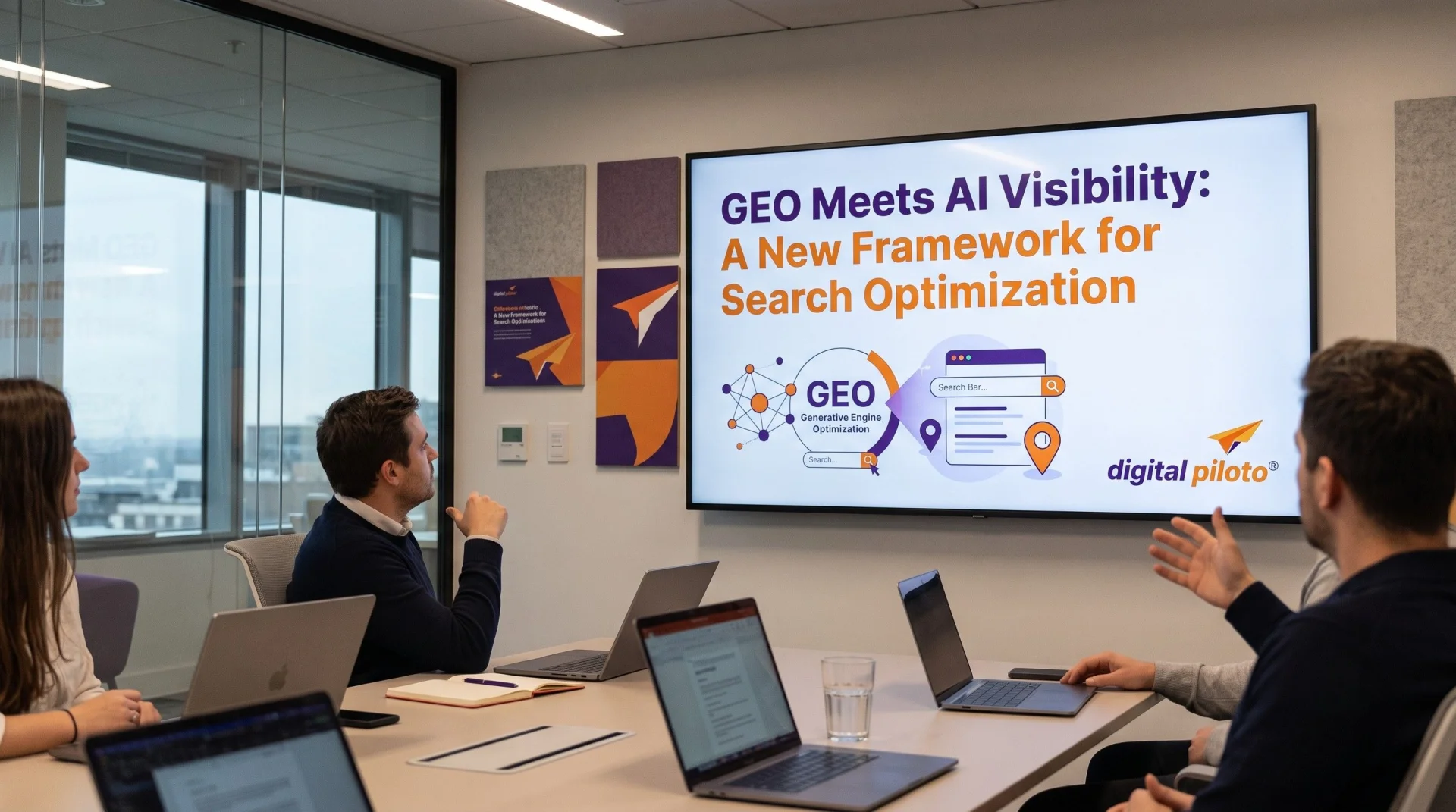
Search is no longer just about helping a webpage reach the first page of results. People increasingly ask AI tools to explain options, compare providers, and recommend solutions before visiting a website. For businesses, this creates a broader challenge: how do you become discoverable, understandable, and trustworthy when an answer may appear before the traditional list of links?
That question sits at the intersection of Generative Engine Optimization (GEO) and AI visibility. A forward-thinking digital marketing company in India must now consider not only how content ranks in search engines, but also whether useful information about a brand can be discovered, interpreted, and cited in AI-generated responses. The goal is not to abandon SEO. It is to expand the definition of search success.
What GEO and AI Visibility Actually Mean
Generative Engine Optimization focuses on making content more useful and accessible to AI-driven search and answer experiences. These systems may retrieve information from websites, combine details from multiple sources, and produce a synthesized response. Depending on the platform and query, they may also provide links or citations.
AI visibility is the broader outcome businesses want to measure: whether their brand, expertise, products, or information appear accurately in relevant AI-assisted discovery experiences. GEO is one way to work toward that outcome, alongside technical SEO, brand development, authoritative content, and digital reputation management.
Consider a company selling accounting software. Traditional SEO might help its product page rank for “cloud accounting software for small businesses.” AI visibility asks a different but related question: when a business owner asks an AI assistant which accounting tools suit a growing company with multiple employees, does the company's product appear accurately in the response?
Neither outcome is guaranteed by a particular content technique. AI systems differ in how they retrieve and select information, and their responses can change. Still, businesses can improve the quality, clarity, and consistency of the information available about them.
Why Traditional SEO Is Still Part of the Framework
It would be a mistake to treat GEO as a replacement for conventional search optimization. Search engines still help users discover websites, and many of the practices that make pages useful to searchers also support AI-assisted discovery.
Google's documentation explains how its AI features fit within existing Search systems and advises website owners to maintain strong fundamentals. Its guidance emphasizes helpful content, accessibility to search systems, and satisfying user needs rather than chasing special tricks for AI results. Businesses can review the official guidance on AI features in Google Search for platform-specific recommendations.
Traditional SEO provides the groundwork through:
- Technical accessibility: Search engines need to discover and process important pages, while users need a website that works reliably across devices.
- Relevant content: Pages should address real customer questions instead of repeating keywords without offering useful answers.
- Clear site structure: Descriptive headings, internal links, and sensible navigation help users understand how information connects.
- Credibility: Evidence, subject expertise, transparent authorship, and legitimate external references help readers assess the quality of information.
These fundamentals do not guarantee an AI citation. They create a stronger foundation from which a business can pursue visibility across conventional search and emerging answer-based experiences.
A New Framework for Search Optimization
A practical GEO and AI visibility strategy needs more than a list of keywords. It should connect the way a brand is described, the usefulness of its content, the sources that support its reputation, and the outcomes it measures.
1. Establish a clear brand identity
AI systems cannot reliably represent a business if the available information about it is contradictory or vague. A company might describe itself as a software developer on one page, a marketing consultancy on another, and a general technology provider across third-party profiles. Prospective customers may struggle to understand what it actually does.
Create a consistent description of the business, its services, audience, expertise, locations, and distinguishing capabilities. Keep this information accurate across the website, professional profiles, business listings, and other relevant sources. Consistency does not mean copying identical text everywhere; it means ensuring the underlying facts agree.
2. Build content around questions and decisions
Keyword research remains useful, but a list of search phrases rarely captures the entire decision-making process. Buyers have questions before, during, and after they understand the product category.
For instance, someone evaluating cybersecurity software may begin by asking how to protect a small business, then compare endpoint tools, and finally investigate deployment requirements. Content that answers only the product-comparison query misses the earlier concerns that shape the decision.
Develop resources that explain concepts, compare realistic alternatives, describe limitations, answer implementation questions, and clarify who a solution suits. Use specific headings and direct answers where they improve readability. Supporting detail should follow naturally, rather than forcing every paragraph into a short, formulaic response.
3. Make important facts easy to verify
Clear claims are more useful than impressive but unsupported language. If a business says its product reduces administrative work, it should explain which tasks it automates and provide relevant evidence where available. If a service is intended for a particular industry, the website should demonstrate that expertise through examples, documentation, or detailed guidance.
Useful evidence can include transparent case studies, documented methods, credible research, expert authorship, product specifications, and genuine customer feedback. Do not invent results or publish anonymous testimonials simply to make a brand appear more authoritative.
Structure Content for Retrieval and Understanding
Well-organized content gives people a clearer route to the answer they need. It can also make relationships between concepts easier for search systems to interpret. This is particularly important for complex B2B topics, where a useful answer may depend on several connected facts.
Imagine a manufacturer explaining industrial filtration equipment. A page that combines every specification, application, maintenance requirement, and limitation into one long paragraph creates unnecessary friction. Separate sections for applications, technical specifications, maintenance, and compatibility make the information easier to navigate.
When reviewing important pages, prioritize these improvements:
- Use descriptive page titles and headings that accurately reflect the subject.
- Place the central answer or definition near the beginning when that helps readers understand the topic quickly.
- Explain technical terms and abbreviations instead of assuming every visitor already knows them.
- Use internal links to connect related guides, service pages, documentation, and supporting evidence.
- Keep product details, dates, prices, policies, and other changing information current.
- Apply relevant structured data when the page meets the applicable guidelines, ensuring that markup matches visible content.
Structured data can help search engines understand eligible information, but it is not a secret route into AI answers. Similarly, adding an FAQ section does not automatically increase visibility. Every element should serve a genuine user need.
Build Authority Beyond Your Own Website
A company's website is important, but it is not the only place where customers encounter information about a brand. Industry publications, professional associations, review platforms, specialist communities, and independent comparisons can all shape a prospective customer's understanding.
This makes reputation and digital public relations relevant to AI visibility. Businesses should earn legitimate mentions by publishing useful research, sharing original expertise, contributing to industry discussions, and maintaining strong customer relationships. The emphasis should be on relevance and credibility, not collecting as many links or mentions as possible.
For teams investing in search engine optimization services india, this means connecting on-site improvements with a broader strategy for content quality, technical health, and brand reputation. No single external mention can guarantee an AI recommendation, but a coherent and credible presence gives customers better grounds for trusting the business.
Connect GEO With Digital Transformation
Search optimization increasingly overlaps with content operations, analytics, customer experience, and technology management. A website team might maintain product data, the marketing department might publish claims about product capabilities, and customer support might use a different description of the same service. Those gaps can create confusion for people and weaken brand consistency.
Well-planned Business Digital transformation services can help align these functions through shared data definitions, content governance, analytics, and consistent customer information. This does not require every business to adopt a complicated technology stack. Even a small team can benefit from a documented source of truth for key facts and a clear process for updating content.
The broader objective is to ensure that the website, marketing messages, product documentation, and customer communications describe the business accurately. GEO works best when it is part of that wider discipline rather than a disconnected publishing tactic.
Measure AI Visibility Without Chasing Vanity Metrics
Traditional SEO metrics such as organic impressions, clicks, rankings, and conversions remain valuable. However, they may not fully explain how a brand appears in AI-assisted experiences, particularly when users receive an answer without clicking through to a website.
Build a measurement approach that combines several kinds of evidence:
- Search performance: Monitor organic impressions, clicks, rankings for relevant queries, and engagement with important landing pages.
- AI answer observations: Test a stable set of relevant prompts across selected platforms and record brand mentions, citations, recommendation accuracy, and competitor presence.
- Content quality: Review whether important questions are answered clearly, key facts are consistent, and supporting evidence remains current.
- Business outcomes: Track qualified enquiries, demo requests, conversions, assisted revenue, and other outcomes tied to the original objective.
Repeat AI prompt tests periodically, noting the date, platform, query wording, and context. Responses can differ across sessions and systems, so avoid treating a handful of results as a complete picture of market visibility. Where possible, compare trends over time and connect them with website and customer data.
Most importantly, distinguish a visibility signal from a commercial result. A brand mention may be encouraging, but it does not necessarily produce a qualified lead. The value lies in understanding which improvements make the brand easier to discover and more useful to potential customers.
Common GEO Mistakes to Avoid
As interest in AI visibility grows, so does the temptation to look for shortcuts. Some advice promises guaranteed citations through specific formatting tricks, excessive FAQ publishing, or keyword repetition. Such promises are difficult to substantiate because AI platforms use different systems and can change how they retrieve and present information.
Instead, avoid these common mistakes:
- Publishing large volumes of near-duplicate content without adding meaningful expertise.
- Using structured data that does not accurately represent the visible page.
- Making unsupported claims about products, customers, or business results.
- Ignoring technical SEO while focusing exclusively on AI-related content changes.
- Measuring success only by mentions, without checking accuracy, engagement, or business impact.
A durable framework should improve the website for real customers even if a particular AI platform never cites it. That is a useful test for deciding whether an optimization effort deserves time and investment.
Frequently Asked Questions
1. What is the difference between GEO and AI visibility?
GEO refers to practices intended to improve content's usefulness and discoverability in generative search experiences. AI visibility describes the broader outcome of whether a brand or its information appears accurately in AI-assisted answers and recommendations.
2. Does GEO replace traditional SEO?
No. Technical SEO, relevant content, crawlability, helpful page structure, and credible information remain important. GEO extends the optimization focus to include how content may be retrieved, summarized, or cited in AI-driven discovery experiences.
3. How can a business improve AI search visibility?
Businesses can improve the clarity and accuracy of their content, answer relevant customer questions, maintain consistent brand information, support claims with credible evidence, and strengthen technical SEO. No specific technique guarantees an AI citation or recommendation.
4. How should businesses track GEO performance?
Combine traditional search metrics with repeatable tests of relevant AI prompts, brand mentions, citations, recommendation accuracy, and commercial outcomes. Record the platform and test conditions because AI responses can vary, and interpret findings as directional rather than universal.
Final Thoughts
GEO and AI visibility are best understood as extensions of a broader search strategy, not replacements for the fundamentals that make websites useful and trustworthy. Businesses that organize their knowledge, answer real questions, support their claims, and measure meaningful outcomes will be better prepared for changing discovery experiences. The aim is simple: make it easier for people—and the systems helping them—to understand why your brand deserves consideration.
Blog Development Credits
This article was conceptualized by Amlan Maiti, developed with AI-assisted research and drafting, then editorially refined and optimized for search relevance by Digital Piloto Private Limited.


Comments (0)
Leave a Comment