
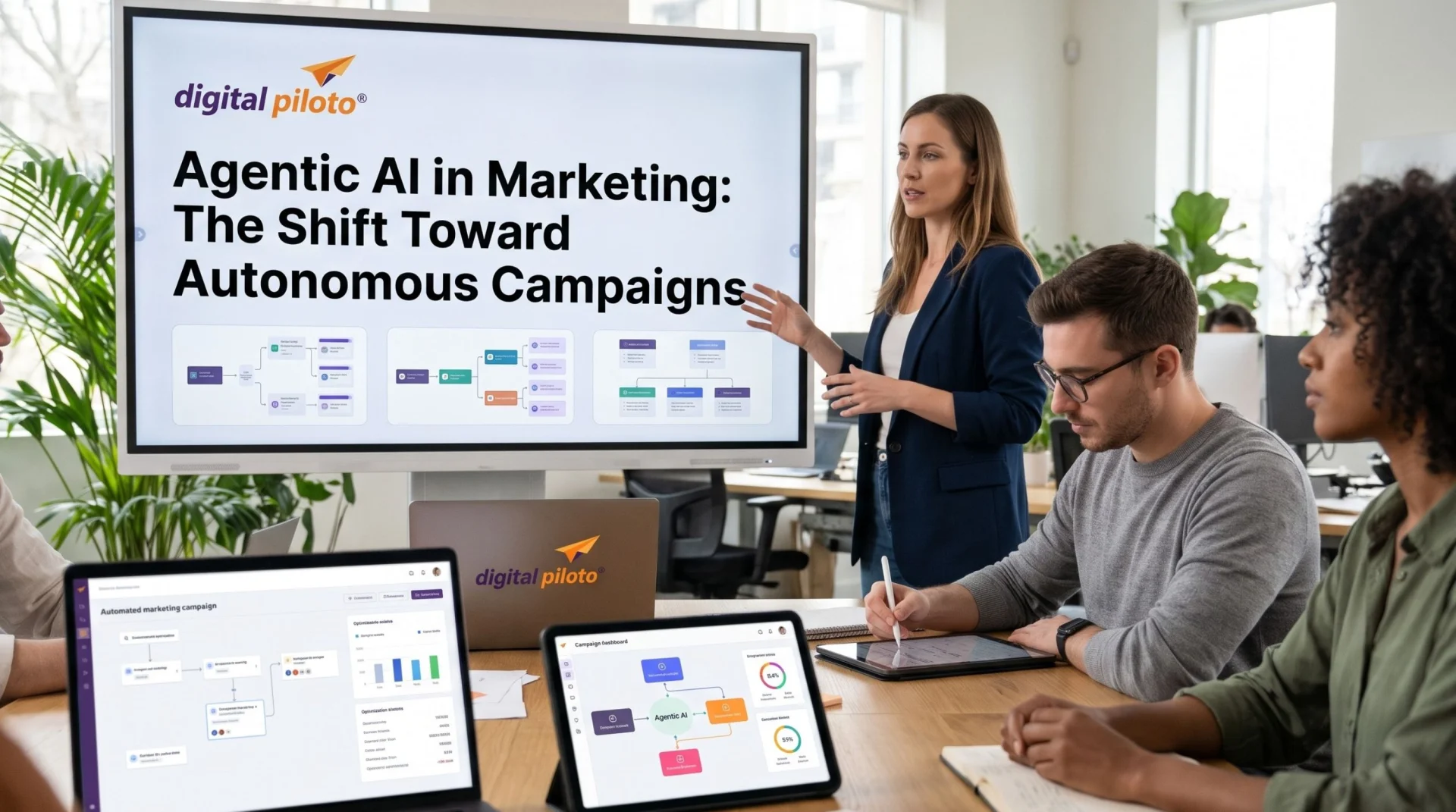
Imagine launching a marketing campaign that does more than follow a fixed schedule. It notices a change in customer behaviour, adjusts its next action, tests a new approach, and learns from the outcome. That is the promise of agentic AI. Marketing is moving beyond simple automation towards systems capable of planning and executing parts of a campaign independently.
For businesses investing in digital marketing services in India, this shift raises an important question: what happens when software can make campaign decisions rather than merely carry out instructions? Agentic AI offers a possible answer. It combines AI reasoning, access to business tools, and defined objectives to complete multi-step tasks. The opportunity is exciting, although successful adoption requires more than switching on an autonomous tool.
What Makes Agentic AI Different from Marketing Automation?
Traditional marketing automation is useful because it removes repetitive work. A platform can send a welcome email after registration, assign a lead to a salesperson, or publish a scheduled social media post. These workflows generally follow rules that people configure in advance.
Agentic AI takes a more flexible approach. An AI agent can receive a goal, examine available information, decide which actions may help, use connected tools, and evaluate the results. Depending on its permissions and design, it may adjust its plan when circumstances change.
Consider a simple example. A traditional automation system sends the same follow-up email three days after a prospect downloads a brochure. An agentic system might examine the prospect's interactions, identify which product information they viewed, check whether a sales conversation has already started, and recommend a more relevant next step.
The distinction is not that one system is intelligent and the other is not. It is that rule-based automation usually follows a predefined path, while an agentic workflow can select between permitted actions according to context.
How Autonomous Marketing Campaigns Work
An autonomous marketing campaign is not necessarily a campaign without human involvement. In practice, it is better understood as a coordinated workflow in which AI agents handle selected decisions and actions while people define the objectives, boundaries, and approval requirements.
1. Understanding the campaign objective
Every campaign needs a clear purpose. It might be generating qualified enquiries, encouraging repeat purchases, promoting a new service, or reducing abandoned carts. An agent needs a measurable goal and enough context to understand what success means.
For example, "increase engagement" is vague. A more useful objective might be to identify inactive subscribers, prepare relevant re-engagement messages, and submit the proposed campaign for approval.
2. Collecting and interpreting information
Agents can work with permitted information from CRM platforms, analytics systems, email tools, product catalogues, and other connected sources. They may use this context to identify customer segments, detect changes in campaign performance, or understand where prospects are dropping out of a funnel.
Data quality matters enormously here. If customer records are incomplete or consent preferences are inaccurate, an agent may make a poor decision with impressive speed. Better automation cannot compensate for unreliable information.
3. Choosing and carrying out actions
Once an agent has enough context, it can select from approved actions. Depending on the system, these might include drafting an email, updating a CRM record, preparing an audience segment, recommending a budget adjustment, or creating a performance summary.
Some actions can be executed automatically within defined limits. Others should require human approval, especially when they involve spending, customer communications, sensitive data, or significant changes to campaign strategy.
4. Reviewing outcomes and adapting
An agentic workflow can compare campaign results against its objective and use the findings to recommend what should happen next. A weak response rate, for instance, may trigger a review of audience relevance or message quality rather than another identical follow-up.
This creates a feedback loop: observe, interpret, act, measure, and refine. The loop can make campaign operations more responsive, provided the system has reliable data and meaningful evaluation criteria.
Where Agentic AI Can Transform Marketing
Not every marketing task needs an autonomous agent. The strongest opportunities tend to appear where several steps, data sources, and decisions are involved.
Lead generation and nurturing
Lead generation often involves more than collecting a name and email address. A prospect may visit a service page, download a guide, compare pricing, and return weeks later. An AI marketing agent can help interpret these interactions, organize relevant CRM information, and suggest an appropriate follow-up.
For a B2B company, this could mean preparing a different message for a prospect researching enterprise solutions than for someone exploring a basic service package. The sales team still needs to validate important decisions, but it may spend less time sorting through routine information.
Personalized customer journeys
Personalization becomes more useful when it responds to what a customer actually does. Agentic workflows can help coordinate product recommendations, email content, and follow-up timing using permitted behavioural signals.
Imagine an online retailer whose customer browses a particular product category but does not purchase. Rather than sending a generic promotional message, an agent might prepare a relevant recommendation or suggest helpful product information. The goal should be relevance, not constant interruption.
Campaign monitoring and optimization
Marketing teams often manage campaigns across search, paid social, email, and other channels. Reviewing every metric manually can become difficult as the number of campaigns grows.
An agent can monitor selected indicators, flag unusual changes, summarize performance, and recommend experiments. For example, it might notice that a campaign is receiving clicks but producing few enquiries. Instead of simply recommending more budget, it could suggest checking the landing page, audience fit, or conversion process.
Content planning and distribution
Content marketing also involves multiple connected tasks: researching questions, developing briefs, coordinating drafts, preparing channel-specific versions, and tracking engagement. Agents can support these activities by organizing research, identifying content gaps, and preparing distribution suggestions.
Human editors should remain responsible for factual accuracy, original insight, brand voice, and sensitive claims. A faster publishing process is not valuable if it produces repetitive or misleading material.
The Business Benefits of Moving Towards Autonomous Campaigns
The appeal of agentic AI is not simply that it sounds advanced. Its value should be judged by whether it helps marketing teams make better use of time, information, and resources.
- Less repetitive coordination: Agents can connect routine steps that would otherwise require several manual handoffs.
- Faster response to changes: Campaign teams can receive timely alerts and recommendations when important performance signals shift.
- More contextual communication: Customer interactions can be shaped around relevant behaviour and available preferences.
- Better operational consistency: Defined workflows can help teams apply agreed processes across campaigns.
- More time for strategic work: Marketers may spend less time gathering information and more time on positioning, creative direction, and customer understanding.
These are potential benefits, not automatic outcomes. Results depend on the quality of implementation, integration, data, and human oversight. An agent that makes unnecessary changes or sends irrelevant messages can create more work than it removes.
What Businesses Need Before Adopting Agentic AI
Moving towards autonomous marketing requires a sensible foundation. Businesses should resist the temptation to connect every platform and grant an agent broad permissions from the beginning.
Build clear operating boundaries
Define what an agent can read, recommend, and execute. Drafting a campaign message is different from sending it to thousands of customers. Reviewing ad performance is different from independently increasing a campaign budget.
A practical starting model is to divide actions into three levels:
- Low-risk actions: Summarizing reports, organizing approved information, and drafting content for review.
- Controlled actions: Updating selected CRM fields, preparing audience segments, or scheduling approved communications within defined rules.
- High-impact actions: Changing substantial budgets, making sensitive customer decisions, or launching major campaigns. These should normally require explicit human authorization.
Connect systems carefully
Agents become more useful when they can access the right tools, but integrations also introduce risk. Businesses should review permissions, authentication, data handling, and the reliability of information exchanged between platforms. Access should be limited to what each agent actually needs.
A digital innovation company in India working on an AI-enabled marketing ecosystem should consider the entire workflow, not just the agent itself. CRM systems, analytics, advertising platforms, website infrastructure, and customer communication tools need to work together without creating unnecessary data exposure or operational confusion.
Keep people accountable
Autonomy should not mean removing responsibility. Marketing teams need clear ownership for campaign objectives, customer consent, brand communication, budget decisions, and performance review. Agents should also provide useful records of the information they used and actions they took, wherever the platform supports that capability.
Businesses should pay particular attention to privacy and applicable data-protection requirements. In India, the Digital Personal Data Protection Act, 2023, provides an important legal framework for handling digital personal data. Organizations should review the relevant obligations and implementation rules with appropriate legal or compliance professionals rather than assuming an AI tool handles them automatically.
Measuring the Performance of Agentic Marketing
Counting the number of tasks completed by an AI agent is not enough. A system might process hundreds of activities without improving the customer experience or business results.
Instead, evaluate the workflow through measures such as:
- Lead quality: Are more enquiries meeting the business's qualification criteria?
- Conversion performance: Are more suitable prospects progressing towards a purchase?
- Response time: Can the team respond to relevant customer actions more quickly?
- Operational efficiency: Is the workflow reducing manual effort without increasing correction work?
- Customer experience: Are communications useful, timely, accurate, and respectful of preferences?
- Financial impact: Do improvements justify the cost of software, integration, monitoring, and human review?
It is also sensible to run controlled pilots. Start with one defined workflow, record its existing performance, introduce the agent with limited permissions, and compare the results. This gives decision-makers a more credible basis for expanding the system.
Why Human Creativity Still Matters
There is a tendency to imagine autonomous marketing as a future in which AI handles every decision. That is probably the wrong way to think about it. Marketing is not just a sequence of operational tasks. It involves understanding people, interpreting cultural context, building trust, and communicating why a product or service deserves attention.
An agent may identify that a particular audience responds well to educational content. A human strategist still needs to decide what the brand should teach, which opinions it should express, and how its message should feel. Similarly, AI can prepare several campaign variations, but creative judgment is needed to choose a direction that is distinctive rather than merely statistically convenient.
For businesses exploring AI-powered marketing automation, the strongest model is likely to combine machine speed with human judgment. Let agents handle suitable coordination and analysis. Let people own the purpose, ethics, relationships, and creative decisions.
Frequently Asked Questions
1. What is agentic AI in marketing?
Agentic AI in marketing refers to AI systems that can work towards defined objectives by interpreting information, planning steps, using connected tools, and carrying out permitted actions. Unlike basic automation, an agent may adapt its workflow when conditions or results change.
2. How are agentic AI and marketing automation different?
Traditional marketing automation generally follows predefined rules and workflows. Agentic AI can use context to select between permitted actions and manage multi-step tasks. Both approaches can work together, with conventional automation handling predictable processes and agents supporting more adaptive activities.
3. Can agentic AI run marketing campaigns without human involvement?
Some routine campaign activities can be automated, but fully unsupervised marketing is rarely a sensible starting point. Human approval is important for high-impact decisions involving budgets, customer data, brand reputation, and external communications.
4. How should a business start using AI marketing agents?
Choose one repetitive, measurable workflow, such as lead qualification or campaign reporting. Check data quality, connect only the necessary tools, set clear permissions, and establish human approval rules. Run a controlled pilot before expanding to more complex campaigns.
Final Thoughts: Make Autonomy Work for People
Agentic AI could change how marketing campaigns are planned, coordinated, and improved. But the real opportunity is not to remove marketers from the process. It is to give them systems that handle appropriate operational work while leaving room for thoughtful strategy and meaningful customer relationships. Businesses that introduce autonomy carefully, measure its value, and keep people accountable will be in a stronger position to make it work.
Blog Development Credits
The topic was conceptualized by Amlan Maiti, developed through research and AI-assisted drafting, then refined and optimized for search by Digital Piloto Private Limited.


Comments (0)
Leave a Comment