

Imagine launching a campaign without manually coordinating every email, report, audience segment, and performance check. That is the promise of AI marketing agents. Rather than simply generating content or following fixed instructions, these systems can work toward defined goals, select suitable actions, and respond to new information—changing how marketing teams plan, execute, and improve campaigns.
For companies investing in growth, an seo optimization company India can help connect search strategy with evolving AI-supported workflows. But the bigger opportunity goes beyond search rankings. AI marketing agents can help businesses coordinate several activities, from customer research to lead qualification, while giving human marketers more time to focus on strategy, creativity, and customer relationships.
What Makes an AI Marketing Agent Different?
Marketing teams already use plenty of automation. A welcome email goes out when someone subscribes, a CRM assigns leads according to predefined rules, and an advertising platform adjusts bids within selected parameters. These tools are useful, but their behavior generally depends on workflows and conditions established beforehand.
An AI marketing agent can approach a broader objective by breaking it into smaller tasks, gathering relevant information, using connected tools, and selecting its next action within permitted boundaries. IBM describes AI agents as systems that can autonomously perform tasks by designing workflows and using available tools. Read its guide to AI agents for an overview of how they operate.
Consider a simple example. A traditional automation system might send a follow-up email three days after a prospect downloads a brochure. An AI agent could also consider whether the prospect visited the pricing page, attended a webinar, or already contacted sales. Depending on its access and instructions, it could recommend a more relevant follow-up or route the prospect to a representative.
The distinction is not that agents can do everything independently. They cannot. Their real advantage is the ability to coordinate multiple steps toward a goal instead of handling just one isolated task.
Why Marketing Is Moving Beyond Basic Automation
Modern campaigns generate more information than most teams can comfortably review by hand. Search trends shift, customer preferences change, advertising costs fluctuate, and potential buyers move between channels before making a decision.
Research from McKinsey offers useful context. Its 2025 global survey on AI found that 62% of respondents said their organizations were at least experimenting with AI agents, while 23% reported scaling an agentic AI system somewhere in the enterprise. The figures reflect survey respondents, not every business, and indicate that adoption was developing rather than universally mature.
That distinction matters. Companies are exploring the technology, but practical implementation still requires thoughtful planning. Marketing leaders must decide which tasks are suitable for independent execution, which need approval, and how to determine whether an agent is genuinely improving results.
Five Ways AI Marketing Agents Can Change Execution
1. Turning market research into campaign plans
Research can consume a surprising amount of a marketer's week. Teams compare competitors, study customer questions, review past campaigns, and look for emerging topics before creating a plan.
A research agent can help assemble this information into a useful starting point. It might analyze approved customer feedback, group search queries by intent, identify gaps in existing content, and prepare a campaign brief around a specific business objective.
For example, a company selling accounting software could discover that small-business owners are searching for guidance about invoice delays rather than software features. An agent might recommend educational content, a downloadable checklist, and a follow-up campaign addressing that problem.
The marketer still checks the evidence and decides which opportunity deserves investment. The benefit is that research can move more quickly into a practical plan.
2. Coordinating content across channels
A campaign rarely succeeds because of one blog post or advertisement. Its message needs to remain consistent across landing pages, email sequences, social media, and other touchpoints.
AI marketing agents can coordinate parts of this process. One agent might gather approved product information, another prepare content drafts, and a review agent check for missing details or inconsistencies. A workflow manager can then route the drafts for human approval.
This can make content operations more organized, especially for businesses managing several products or regional campaigns. Still, publishing should not become a race to produce more pages. Brand accuracy, originality, usefulness, and editorial judgment remain important.
3. Making SEO more responsive
Search optimization is not a one-time task. Pages lose relevance, competitors publish stronger resources, technical issues emerge, and customer search behavior evolves.
An AI agent can monitor available performance data, flag unusual changes, and suggest the next investigation. If organic traffic declines on an important service page, for instance, it might compare recent search queries, identify outdated sections, and prepare a prioritized content update plan.
With appropriate access, an agent could carry out low-risk checks or update approved reporting dashboards. However, significant site changes—such as mass redirects, major technical modifications, or large-scale content replacement—should have suitable review and rollback procedures.
The objective is proactive SEO management, not blind automation. A recommendation should be evaluated against search intent, business priorities, and actual evidence before it becomes a permanent change.
4. Improving lead qualification and nurturing
Not every enquiry deserves the same response. Someone comparing solutions for a future project may need educational material, while a prospect requesting pricing could be ready for a sales conversation.
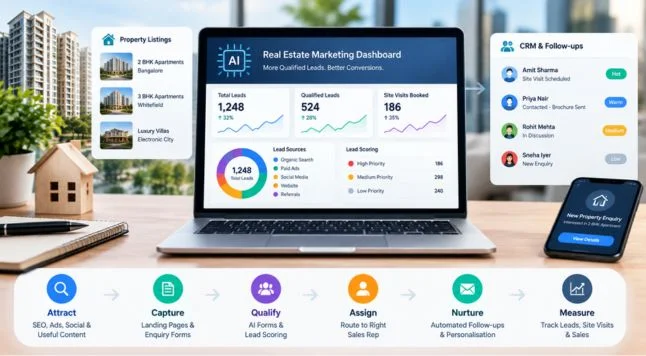
An agent can bring together permitted CRM details, website interactions, and enquiry information to help assess intent. It might classify a lead, suggest a relevant resource, draft a follow-up message, or transfer the conversation to a sales representative.
Imagine a B2B company receiving enquiries through forms, email, and paid campaigns. Instead of asking sales staff to manually assemble every prospect's history, an agent could prepare a concise summary and recommend the next step. The employee enters the conversation with better context and less administrative work.
Personalization must be handled responsibly. Businesses should respect consent, communication preferences, privacy requirements, and the limits of the information they have collected.
5. Responding to campaign performance
Campaign optimization often loses momentum between reporting and action. A dashboard might reveal that clicks have increased while qualified leads remain flat, yet the team may not investigate the issue until its next review meeting.
An agent could detect the gap, investigate possible causes, and recommend an experiment. Perhaps the advertisement promises a benefit that the landing page does not explain clearly. Or the campaign attracts visitors whose needs do not match the offer.
Where permissions allow, the system might run an approved low-risk test and monitor the outcome. Larger budget changes or decisions affecting significant revenue should generally require human authorization.
How to Build an Autonomous Marketing Workflow
Effective agentic marketing starts with a specific outcome—not simply installing an AI tool and hoping it discovers something useful. A well-designed workflow connects a goal with reliable data, approved tools, measurable results, and clear limits on what the system can do.
- Choose a focused use case. Start with a task such as identifying declining content performance, preparing lead summaries, or coordinating campaign reports.
- Connect the right information. Make relevant analytics, CRM, website, or campaign data available while limiting access to what the agent actually needs.
- Define permissions and approval points. Decide which actions can run independently and which require a person's authorization.
- Measure business outcomes. Track qualified leads, conversion rates, time saved, acquisition costs, or revenue—not just the number of tasks completed.
- Test before expanding. Review errors, compare results with a baseline, and improve the workflow before connecting more systems or increasing autonomy.
For organizations connecting marketing platforms with websites, analytics, and customer systems, a technology solutions company in India may help assess integration requirements and operational readiness. The priority should be building a connected, manageable workflow rather than adding complexity for its own sake.
Human Oversight Is Still Essential
The phrase “autonomous execution” can sound as though marketers are about to hand over their entire operation. In practice, useful autonomy is usually bounded. Agents need a clear objective, access to suitable tools, and rules that prevent actions from creating unnecessary risk.
Before deploying an agent, businesses should establish a few practical safeguards:
- Protect customer data: Apply appropriate access controls and follow relevant privacy, security, and retention requirements.
- Review consequential decisions: Keep people involved in sensitive communications, major budget adjustments, and important brand claims.
- Maintain action records: Record important decisions, the data used, and the resulting changes so teams can investigate problems.
- Provide an emergency stop: Make it possible to pause a workflow when unexpected behavior, unreliable output, or unusual performance appears.
There is also a people challenge. Marketing teams need to learn how to evaluate agent recommendations, spot unreliable assumptions, and intervene when a situation falls outside normal expectations. The best implementation improves employees' judgment rather than discouraging them from using it.
Measuring Success Beyond Time Saved
Saving hours is useful, but it is not the only measure of success. An agent could generate reports quickly without improving campaign performance. It could also produce a large volume of leads that rarely convert.
Businesses should compare performance before and after deployment. Depending on the workflow, useful indicators might include:
- Time required to respond to qualified enquiries.
- Conversion rate from lead to sales opportunity.
- Cost per qualified lead or customer acquisition.
- Time spent on manual reporting and repetitive coordination.
- Rate of errors, escalations, and human corrections.
Review these indicators together. Faster execution is valuable only when accuracy, customer experience, and commercial outcomes remain healthy. A digital marketing company in India working with AI agents should be able to explain not only which activities have been automated, but also how those activities support the client's business goals.
Frequently Asked Questions
1. What are AI marketing agents?
AI marketing agents are systems designed to pursue defined marketing goals by gathering information, planning tasks, using connected tools, and taking permitted actions. They can support activities such as campaign research, lead qualification, content coordination, and performance monitoring.
2. How are AI marketing agents different from automation tools?
Traditional automation generally follows predefined rules and triggers. AI agents can evaluate context, coordinate multiple steps, and select from available actions to pursue a goal, subject to their capabilities and permissions.
3. Can AI marketing agents manage SEO campaigns independently?
They can assist with monitoring, analysis, prioritization, and selected approved tasks. However, strategic decisions and significant website changes should receive appropriate human review to protect quality, relevance, and technical stability.
4. Are AI marketing agents suitable for small businesses?
Yes, if the use case is practical and the costs are justified. Small businesses can begin with focused workflows such as lead summaries, campaign reporting, or content monitoring before expanding to more complex systems.
Final Thoughts
AI marketing agents represent a shift from automating individual tasks to coordinating work around meaningful business objectives. They can help teams research faster, respond to customers more intelligently, and identify campaign problems before they become harder to fix.
But autonomy alone is not the goal. The real measure is whether the system delivers better outcomes with appropriate oversight. Start small, connect reliable data, establish clear boundaries, and expand when the evidence supports it. When human expertise and autonomous execution work together, AI becomes more than another marketing tool—it becomes a practical part of how marketing gets done.
Blog Development Credits
This article was conceptualized by Amlan Maiti, developed with advanced AI research assistance, and refined for search performance by Digital Piloto Private Limited.
Comments (0)
Leave a Comment