
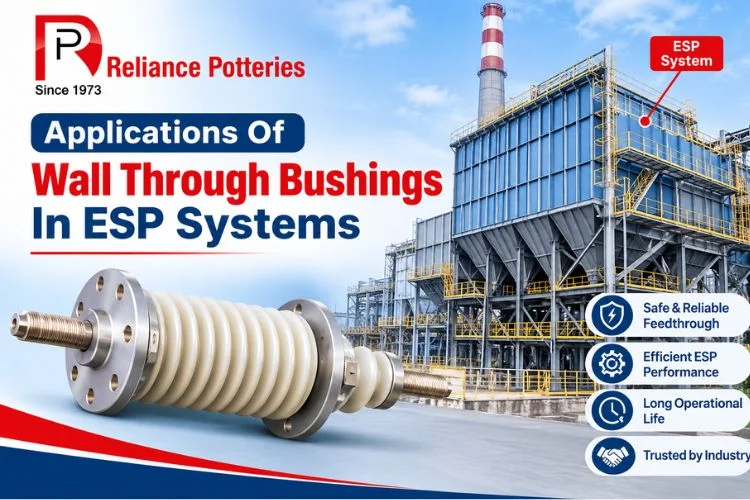
Electrostatic precipitators (ESPs) use high-voltage electrical fields to remove suspended particles from industrial gas streams. To maintain reliable electrical connections, certain ESP designs require insulated conductors to pass through the equipment enclosure without making contact with its grounded metal structure. Wall-through bushings perform this important function.
Wall Through Bushings for ESP provide an insulated passage for conductors across the casing boundary. Reliance Potteries manufactures these products using an MS flange and shaft assembly with alumina porcelain, with customised sizing available for application requirements.
Also Read: How Voltage Rating Determines Electrical Insulator Selection
How Does a Wall-Through Bushing Work in an ESP?
A wall-through bushing is fitted at a designated opening in an ESP enclosure. Its insulating body separates the electrical conductor from the surrounding metal casing while allowing the conductor to maintain its intended electrical connection between the external and internal equipment.
This separation is important because the ESP casing is generally grounded, while parts of its electrical system operate at high voltage. The bushing helps maintain the required insulation at the point where the conductor crosses the enclosure boundary.
Major Applications of Wall-Through Bushings in ESP Systems
1. High-Voltage Conductor Feedthrough
One of the main applications is providing an insulated passage for a high-voltage conductor through an ESP wall. Depending on the equipment layout, the connection may link an external high-voltage supply arrangement with an internal conductor or bus system.
2. Electrical Isolation from the ESP Casing
The porcelain insulating body helps prevent unintended electrical contact between the live conductor and grounded enclosure. Correct electrical clearances and creepage distances are essential to dependable insulation performance.
3. Maintaining Electrical Connection Across Enclosure Boundaries
Industrial ESP installations use electrical connections between external power equipment and internal high-voltage components. A properly specified wall bushing maintains an insulated passage at the enclosure interface.
4. Providing a Secure Mounting Interface
Flange-based assemblies provide a defined mounting arrangement at the wall opening. Correct dimensions, bolt positions, alignment and sealing details help ensure that the component fits the equipment design.
5. ESP Maintenance and Retrofitting
During equipment upgrades or replacement work, damaged or unsuitable wall bushings may need to be replaced. Matching the existing installation requires more than checking physical dimensions: engineers must also verify electrical duty, environmental conditions and connection arrangements.
Wall-Through Bushing vs Other ESP Insulators
| Component | Primary function |
|---|---|
| Wall-through bushing | Allows an electrical conductor to pass through the ESP enclosure while maintaining insulation. |
| Support insulator | Supports the high-voltage electrode or frame assembly and electrically isolates it from grounded structures. |
| Shaft insulator | Provides electrical isolation within the shaft or rapping-drive arrangement. |
These components serve different functions. A wall-through bushing should not automatically be treated as a replacement for a support or shaft insulator.
What Should Engineers Check Before Selecting a Wall Bushing?
Correct specification is essential for dependable operation. Before ordering, engineers and procurement teams should review the following information:
- Electrical requirements: Operating voltage, DC or AC duty, transient conditions and required insulation performance.
- Creepage and clearance: Electrical separation requirements based on voltage, geometry and contamination exposure.
- Dimensions: Overall length, wall thickness, flange diameter, bolt arrangement and conductor interface.
- Material: Suitable porcelain or high-alumina ceramic grade and verified material properties.
- Operating environment: Temperature, thermal cycling, moisture, dust and chemical exposure.
- Mechanical requirements: Mounting loads, alignment, vibration and metal fitting characteristics.
- Testing and documentation: Applicable tests, inspection records, drawings and agreed acceptance criteria.
There is no universal voltage or temperature rating that should be assumed for every ESP wall bushing. The final selection must follow the equipment manufacturer's design and the purchaser's approved technical specification.
Maintenance Considerations
Dust deposits, moisture, cracks and surface damage can compromise electrical insulation. An EPA inspection manual identifies moisture and dust accumulation as potential causes of conductive surfaces, cracking and electrical breakdown in ESP insulators.
During authorised shutdown inspections, maintenance teams should examine the porcelain surface, mounting assembly, contamination, corrosion and signs of electrical tracking. Cleaning and replacement should follow the plant's approved procedures. Electrical isolation, discharge and grounding must be completed before inspection or maintenance.
Standards and Quality Considerations
IEC 60137:2017 provides requirements for insulated bushings used in specified high-voltage applications. Its application to DC bushings is subject to agreement between the purchaser and supplier. Therefore, engineers should establish the relevant standards and tests according to the actual ESP circuit and project specification rather than assume one standard covers every design.
Choosing experienced Insulator Suppliers in India can help procurement teams obtain application-specific product information, drawings and manufacturing documentation.
Frequently Asked Questions
What is the main purpose of a wall-through bushing in an ESP?
Its main purpose is to provide an insulated passage for an electrical conductor through the ESP enclosure while maintaining separation from the grounded casing.
Which material is commonly used for ESP wall bushings?
Ceramic and high-alumina porcelain are used for ESP insulating components. The appropriate material grade should be confirmed against the required electrical, thermal and mechanical conditions.
Are wall-through bushings and support insulators interchangeable?
No. Wall-through bushings provide insulated conductor passage through an enclosure wall, while support insulators primarily hold and isolate internal high-voltage structures.
Can wall-through bushings be customised?
Yes. Dimensions and mounting configurations can be developed according to equipment drawings and customer requirements, subject to technical feasibility.
Choose the Right Wall-Through Bushing for Your ESP
A properly specified wall-through bushing helps maintain electrical isolation at critical ESP enclosure penetrations. Material selection, insulation requirements, mounting geometry and operating conditions should all be considered before procurement.
Reliance Potteries manufactures high-tension electro-porcelain insulators, including customised wall-through bushings for ESP applications. Visit the Wall Through Bushing for ESP product page to review the available product information and submit your project requirements for a technical enquiry.
Also Read: Best Insulator Suppliers in India for Industrial Needs
Blog Development Credits:
This article was thoughtfully developed by Reliance Potteries. Research was supported with modern AI platforms, followed by careful human editing, technical refinement, and SEO optimization by Reliance Potteries to ensure accuracy and readability.



Comments (0)
Leave a Comment