
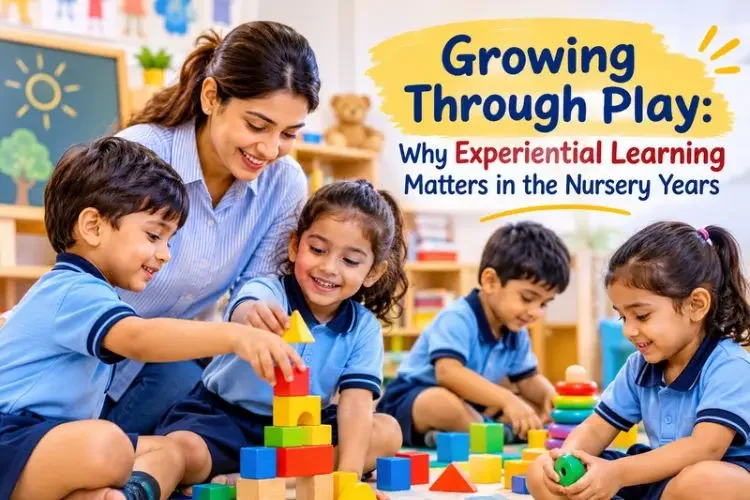
Ruby Park Public School recognises that young children learn best when they can explore, experiment and participate actively. Experiential learning through play helps nursery students develop essential cognitive, social, emotional and communication skills while enjoying the learning process. For parents exploring Nursery Admission in CBSE School Kolkata, understanding the value of play-based education can help them make a more informed decision about their child's first school experience.
What Is Experiential Learning in Nursery Education?
Experiential learning is an approach in which children understand concepts through direct experiences rather than simply listening to explanations or memorising information. It encourages them to learn by doing, observing, questioning and discovering.
In nursery classrooms, this approach can include building blocks, storytelling, painting, nature walks, role-playing, music, puzzles and simple group activities. Each experience introduces opportunities to develop new abilities.
For example, when a child sorts objects according to colour or size, they are beginning to understand classification and comparison. When they build a tower using blocks, they explore balance, shapes, spatial awareness and problem-solving without necessarily realising that they are learning mathematical concepts.
Why Is Learning Through Play Important During the Nursery Years?
The nursery years are an important period of early childhood development. Children are naturally curious, energetic and eager to understand the world around them. Play provides a comfortable environment where they can turn that curiosity into meaningful learning.
1. Develops Thinking and Problem-Solving Skills
When children play with puzzles, building blocks or sorting games, they learn to recognise patterns, make comparisons and find solutions. Instead of receiving every answer from an adult, they get opportunities to think independently.
Consider a child trying to fit differently shaped blocks into a container. They may make several attempts before finding the right combination. This small activity introduces patience, logical thinking and experimentation.
2. Strengthens Communication and Language Skills
Play naturally encourages conversation. During storytelling, pretend shopping or group activities, children learn new words, express their thoughts and listen to others.
Role-playing is particularly useful. When children pretend to be doctors, teachers or shopkeepers, they practise everyday conversations and gradually become more comfortable expressing themselves.
3. Encourages Social and Emotional Development
Playing with classmates introduces children to sharing, cooperation, turn-taking and understanding different emotions. These experiences help them develop positive relationships.
They also learn how to handle small disappointments. Waiting for a favourite toy or accepting another child's idea can teach emotional regulation in a natural, age-appropriate way.
4. Improves Creativity and Imagination
Creative activities allow children to explore ideas without worrying about getting everything right. Drawing, music, storytelling and imaginative games encourage original thinking.
A cardboard box can become a spaceship, a house or a train. Such open-ended activities allow children to make decisions and express their individual personalities.
5. Supports Physical and Motor Development
Physical play is equally important. Activities such as running, jumping, dancing, clay modelling and drawing help children develop coordination and body awareness.
While outdoor games support larger muscle movements, activities such as threading beads, turning pages and using crayons strengthen fine motor skills that are useful for future classroom activities.
How Does Experiential Learning Work in a Nursery Classroom?
Effective experiential learning follows a simple process: children experience something, explore it, understand what happens and gradually apply what they have discovered.
For instance, a classroom activity about plants can follow these steps:
- Observe: Children look at leaves, flowers, seeds and small plants.
- Explore: They touch different textures, compare shapes and notice colours.
- Participate: With appropriate supervision, they place seeds in soil and water them.
- Discover: They observe changes as the plant grows over time.
- Express: They describe what they noticed through drawings, conversations or simple storytelling.
This process transforms an ordinary lesson into a memorable experience. Children are not just hearing about plants; they are actively discovering how living things grow.
Which Play-Based Activities Help Nursery Children Learn?
Parents often assume that educational activities must involve worksheets, books or structured lessons. However, simple everyday experiences can offer equally meaningful learning opportunities.
Some valuable activities include:
- Sorting games: Grouping coloured objects, shapes or toys develops early mathematical understanding.
- Storytelling sessions: Listening to stories and discussing characters strengthens language and imagination.
- Art and craft: Painting, colouring and clay modelling encourage creativity and fine motor coordination.
- Water and sand play: Supervised exploration introduces concepts such as quantity, texture and measurement.
- Role-playing: Pretend household or community activities develop communication and social awareness.
- Outdoor exploration: Observing birds, plants and insects encourages curiosity about the natural environment.
The objective is not to make every activity complicated. Sometimes, the simplest experiences create the strongest learning opportunities.
What Should Parents Look for in a Play-Based Nursery Environment?
Choosing a nursery is about more than checking facilities or comparing academic routines. Parents should understand how a school encourages children to participate, explore and develop at their own pace.
When evaluating a CBSE School Admission in Kolkata opportunity, consider the following aspects:
- Interactive classrooms: Are children encouraged to participate rather than remain passive listeners?
- Age-appropriate activities: Do learning experiences match children's developmental abilities?
- Supportive teachers: Do educators encourage questions and guide children patiently?
- Safe learning spaces: Are classroom materials and play areas suitable for young learners?
- Balanced development: Does the school provide opportunities for creative, physical, social and cognitive growth?
- Individual attention: Are different learning speeds and personalities respected?
Parents considering the Best CBSE Board School in Kolkata should look beyond academic promises and understand how the school creates meaningful everyday learning experiences.
How Can Parents Encourage Experiential Learning at Home?
Learning does not stop when children leave the classroom. Parents can reinforce their child's development through small, enjoyable activities at home.
- Allow children to help with simple household tasks, such as sorting toys or arranging books.
- Read picture books together and encourage them to describe what they see.
- Provide crayons, paper, building blocks and age-appropriate creative materials.
- Spend time outdoors and encourage children to observe plants, animals and their surroundings.
- Ask simple open-ended questions such as, "What do you think will happen next?"
Most importantly, allow children to make mistakes and discover solutions independently whenever it is safe to do so. Constant correction can sometimes discourage curiosity.
Frequently Asked Questions (FAQs)
Q. What is experiential learning in nursery education?
A. Experiential learning is an educational approach where children understand concepts through practical activities, exploration, observation and direct participation instead of relying only on memorisation.
2. Why is play-based learning important for nursery children?
Play-based learning supports cognitive development, communication, creativity, social interaction, emotional understanding and physical coordination during early childhood.
3. Does learning through play prepare children for formal education?
Yes. It helps children develop foundational abilities such as listening, following instructions, problem-solving, communication and cooperation, which support their transition into more structured learning environments.
4. What are some examples of experiential learning activities for nursery students?
Storytelling, building blocks, nature exploration, painting, puzzles, role-playing, sorting games and supervised water or sand activities are useful examples.
5. How can parents identify a good nursery school for experiential learning?
Parents should look for safe classrooms, supportive teachers, interactive activities, age-appropriate learning materials and opportunities for children to explore, communicate and develop at their own pace.
Conclusion:
Early education should not be measured only by how many letters a child recognises or how quickly they complete a worksheet. It should also consider how confidently they communicate, how creatively they think and how comfortably they interact with others.
Experiential learning makes these abilities part of everyday childhood. When children receive the freedom to explore within a safe and supportive environment, play becomes much more than entertainment. It becomes the foundation for lifelong learning, curiosity and confidence.
Blog Development Credit:
This article was developed using insights from current education research and content trends, including perspectives from CBSE, the Ministry of Education, UNESCO, ChatGPT, Google Gemini and contemporary school-education resources. The content strategy, SEO optimisation and final publishing were managed by Ruby Park Public School.


Comments (0)
Leave a Comment