
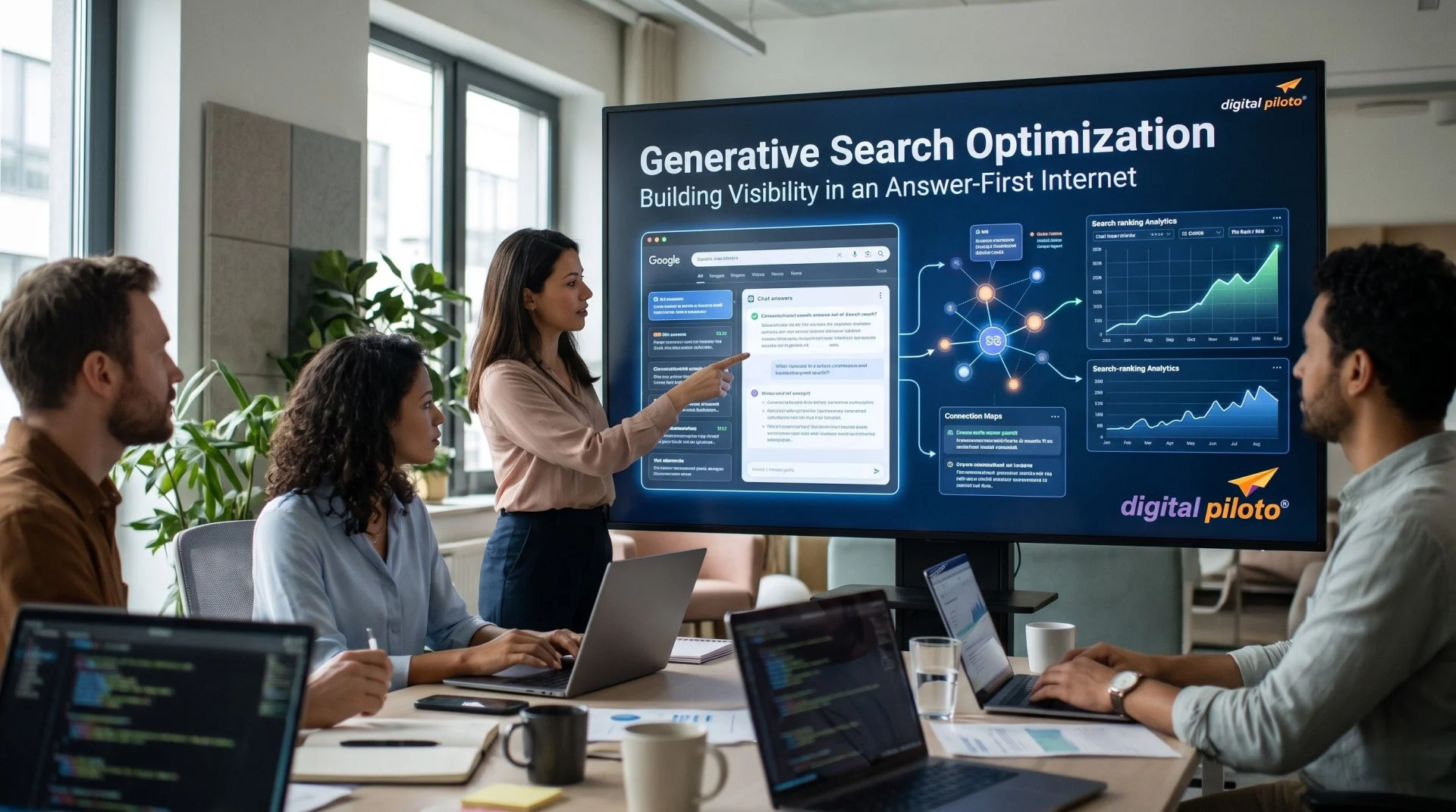
The internet is changing from a place where people search for information to one where they increasingly expect information to come together for them. AI-powered search can summarise, compare, and recommend before a user visits a website. For businesses, the challenge is clear: become a source of information worth finding, understanding, and referencing.
This is where a well-planned digital marketing company in India strategy becomes valuable. Brands need more than keyword rankings; they need useful content, a recognisable identity, and a digital presence that search systems can interpret. Generative Search Optimization, often called GEO, offers a way to think about this changing landscape.
1. What Is Generative Search Optimization?
Generative Search Optimization is the practice of improving how a brand's information can be discovered, understood, and referenced by AI-powered search experiences. These experiences may include Google AI Overviews, ChatGPT Search, Microsoft Copilot, and other conversational tools that retrieve information and produce generated answers.
Traditional SEO largely focuses on helping relevant web pages appear in search results. GEO extends the visibility conversation. It considers whether a business has clear, reliable information that an AI system can retrieve and use when responding to a relevant question.
Imagine a business owner asking an AI assistant, "Which companies provide ecommerce development for growing retail brands?" The answer may contain a short list, explanations, and links to supporting sources. A company that wants to be considered needs more than a page repeating "ecommerce development company". Its website should clearly explain its services, experience, specialisations, and the problems it solves.
There is no guaranteed formula for being included in generated answers. GEO is better understood as a practical framework for improving discoverability and information quality, not a shortcut to automatic recommendations.
2. Why Search Is Becoming Answer-First
People have always wanted quick answers. What is changing is how search platforms deliver them. Instead of requiring users to open several pages and combine the information themselves, AI-powered experiences can summarise material, compare viewpoints, and suggest relevant follow-up questions.
This can make research easier, but it also changes the relationship between search visibility and website traffic. A person may learn about a product or understand a service without clicking through to the original source.
A July 2025 Pew Research Center analysis of browsing activity from 900 U.S. adults found that users clicked a traditional search result in 8% of visits where a Google AI summary appeared, compared with 15% of visits without one. Links within the AI summaries received clicks in only 1% of visits. The study examined U.S. browsing activity during March 2025, so its findings should not be treated as a universal measure of every market. Still, they illustrate why businesses need to consider visibility beyond clicks.
The lesson is not that website traffic no longer matters. It absolutely does. Rather, businesses should also consider whether their expertise is visible during the research stage, when customers are forming opinions and narrowing their choices.
3. Create Content That Answers Complete Questions
One of the most practical GEO improvements is to move beyond isolated keyword placement. People often ask detailed questions that combine several needs. A business should create content that addresses the complete problem instead of focusing only on a short search phrase.
For example, someone searching for a digital marketing partner might want to understand pricing, campaign management, reporting, lead quality, and expected timelines. A thin service page that simply lists SEO, PPC, and social media management will leave many of those questions unanswered.
Build pages around real customer concerns
Useful content can take several forms:
- Detailed service pages: Explain what a service includes, who needs it, and how the process works.
- Comparison guides: Help readers understand differences between solutions, tools, or approaches.
- Practical tutorials: Break complicated tasks into clear, manageable steps.
- Industry-specific resources: Address challenges that matter to a defined audience or business sector.
- Question-led articles: Answer the questions sales teams, customers, and support staff hear repeatedly.
Use descriptive headings and answer important questions directly. Then add the context, examples, and supporting detail readers need to understand the subject properly. A concise answer is useful; a shallow answer is not.
4. Make Your Brand and Expertise Easy to Understand
AI systems cannot reliably interpret a business identity if its information is vague or contradictory. A company should explain what it does, whom it serves, where it operates, and what makes its offering relevant.
Think of your website as a well-organised company profile rather than a collection of promotional pages. Your homepage should establish the business identity. Service pages should explain individual offerings. About pages should provide meaningful background, while author profiles and case studies can demonstrate relevant experience.
Strengthen your brand's information signals
Review these elements regularly:
- Use a consistent official business name, website, and contact information.
- Describe services accurately across your website and important external profiles.
- Provide genuine author details and relevant professional experience.
- Support important claims with verifiable examples, evidence, or references.
- Keep business listings, product details, and location information current.
Consistency does not mean every platform needs identical wording. A LinkedIn profile can be more conversational than a formal service page. The important point is that the underlying facts remain aligned.
5. Structure Information for Better Interpretation
Useful content needs a clear structure. When a page jumps between unrelated subjects, hides important details, or uses vague headings, readers have to work harder to understand it. Clear organisation makes the experience easier for people and helps search systems interpret the information.
Use meaningful H2 and H3 headings, logical paragraph sequences, descriptive link text, and relevant internal links. Put essential facts in accessible text rather than relying entirely on images, animations, or decorative elements.
Structured data can provide additional context about organisations, products, articles, and local businesses. However, it must accurately represent the visible page content. Adding schema markup does not guarantee that an AI platform will cite a page.
Google's official guidance is particularly useful here. It explains that established SEO practices remain relevant to AI Overviews and AI Mode, and that no special AI schema or additional technical requirement is needed for inclusion. Pages must still meet normal search eligibility requirements, and inclusion is not guaranteed.
6. Build Authority Beyond Your Own Website
A business does not establish credibility by describing itself as an industry leader. Trust becomes more convincing when useful information and genuine experience can be found across relevant sources.
Industry publications, professional associations, credible directories, customer reviews, partner websites, and expert contributions can all help people understand a brand's reputation. The goal is not to collect as many mentions as possible. It is to earn relevant references that make sense in the context of your expertise.
For instance, a company specialising in cloud software could contribute a technical explanation to an industry publication, publish an original implementation guide, or share practical lessons from a real project. Such resources give others a meaningful reason to reference its knowledge.
Reviews also matter to customer confidence. Encourage genuine feedback, respond constructively, and avoid fabricated testimonials or misleading claims. Reputation is built through repeated evidence, not manufactured popularity.
For organisations developing a connected digital presence, a digital solutions company in India can help align website development, marketing technology, data, and customer experience. These activities work best when they support one clear brand identity rather than operating as disconnected projects.
7. Keep Traditional SEO at the Centre of GEO
GEO should not be treated as a replacement for SEO. Search engines still need to crawl, understand, and index public website content. Customers still use conventional search results to find service providers, compare products, and access detailed resources.
Technical SEO, mobile usability, page experience, internal linking, and content quality remain important. A business should first make sure its website works properly before investing heavily in speculative AI optimisation tactics.
This is where an experienced best SEO services India strategy can support broader generative search optimisation. The objective is to connect keyword research, search intent, technical health, content depth, and brand authority into one coherent approach.
Be cautious of claims that a particular file, prompt, schema type, or repeated phrase guarantees AI recommendations. Search platforms use different systems, and their responses can vary. A dependable strategy focuses on what a business can control: accurate information, accessible pages, useful resources, and a credible online presence.
8. Measure Whether Your Content Is Being Referenced
Traditional SEO reporting usually focuses on impressions, rankings, clicks, and conversions. GEO introduces additional questions. Which pages are being cited in AI-generated answers? What kinds of topics are associated with those citations? Is the brand appearing for questions that matter commercially?
Microsoft's AI Performance report in Bing Webmaster Tools provides publishers with information about pages cited in supported AI-generated answers across Microsoft Copilot, AI-generated summaries in Bing, and selected partner experiences. It also shows citation trends and grouped grounding queries. Microsoft makes clear that citation counts are not the same as clicks, rankings, or a measure of authority.
Develop a simple GEO measurement routine
- Choose relevant questions: Build a list of realistic questions customers ask before choosing your product or service.
- Test different platforms: Review relevant AI search experiences and record whether your brand or pages appear.
- Monitor cited pages: Use available reporting tools to identify which resources receive citation visibility.
- Review information accuracy: Check whether your services, company details, and expertise are represented correctly.
- Connect visibility with outcomes: Compare referral visits, branded searches, enquiries, and conversions over time.
Do not treat one successful AI response as proof of a lasting ranking. Results may change with the question, location, platform, available sources, and system updates. Look for patterns over time rather than isolated appearances.
9. Make GEO an Ongoing Content Practice
Generative search optimisation is not a one-time website adjustment. Customer questions change, services evolve, and search platforms introduce new experiences. Businesses need a regular process for reviewing important pages and identifying information gaps.
Start with your most valuable service and informational pages. Update outdated details, improve unclear explanations, add missing evidence, and connect related resources through internal links. Where a page attracts attention but does not help visitors take the next step, improve its calls to action and supporting information.
AI tools can assist with research and drafting, but human review remains essential. Check facts, add real business knowledge, and remove generic statements that could describe almost any company. Original experience is more valuable than another article repeating familiar advice.
Frequently Asked Questions
1. What is Generative Search Optimization?
Generative Search Optimization, or GEO, is the practice of improving a brand's discoverability and the clarity of its information across AI-powered search experiences that generate answers using retrieved sources.
2. Is GEO different from traditional SEO?
GEO places additional emphasis on visibility within AI-generated answers and citations. It builds on many traditional SEO foundations, including accessible pages, useful content, clear structure, and credible information.
3. Does GEO guarantee that AI platforms will recommend a business?
No. AI platforms use different retrieval and response systems, and no optimisation method guarantees a mention or citation. GEO focuses on improving the quality, clarity, and discoverability of business information.
4. How can businesses measure GEO performance?
Track available AI citation reports, relevant platform mentions, cited pages, referral traffic, branded searches, and qualified enquiries. Review trends over time instead of relying on a single AI response.
Final Thoughts
In an answer-first internet, visibility is no longer just about appearing among search results. It is also about becoming a useful and credible source when people ask questions and explore options. Businesses that combine strong SEO foundations with clear expertise, reliable content, and consistent brand information will be better prepared for the next stage of search.
Blog Development Credits
Developed from an idea by Amlan Maiti, this article was researched with ChatGPT, Google Gemini, and Copilot, then refined for search by Digital Piloto Private Limited.

Comments (0)
Leave a Comment